
AI search optimization is the work of making your practice visible and accurately represented across every AI surface patients now use to find care: Google AI Overviews, ChatGPT, Perplexity, Gemini, and Copilot. It is one discipline, not five, because every surface rewards the same foundation: a clean entity, extractable content, and third-party corroboration. The playbook below is the operating system I install for medical practices, in the order the work should happen: audit, entity foundation, content structure, measurement, and team workflow.
My background shapes how this is organized. I spent 20 years as an enterprise software engineer, including building a platform from zero to $500M, and I have been a functional medicine patient for 15 years. When I look at AI search, I do not see a marketing trend, I see a distributed system with inputs you control and outputs you can measure. Practices that treat it that way win. Practices that treat it as a pile of tips do a few random things and quit.
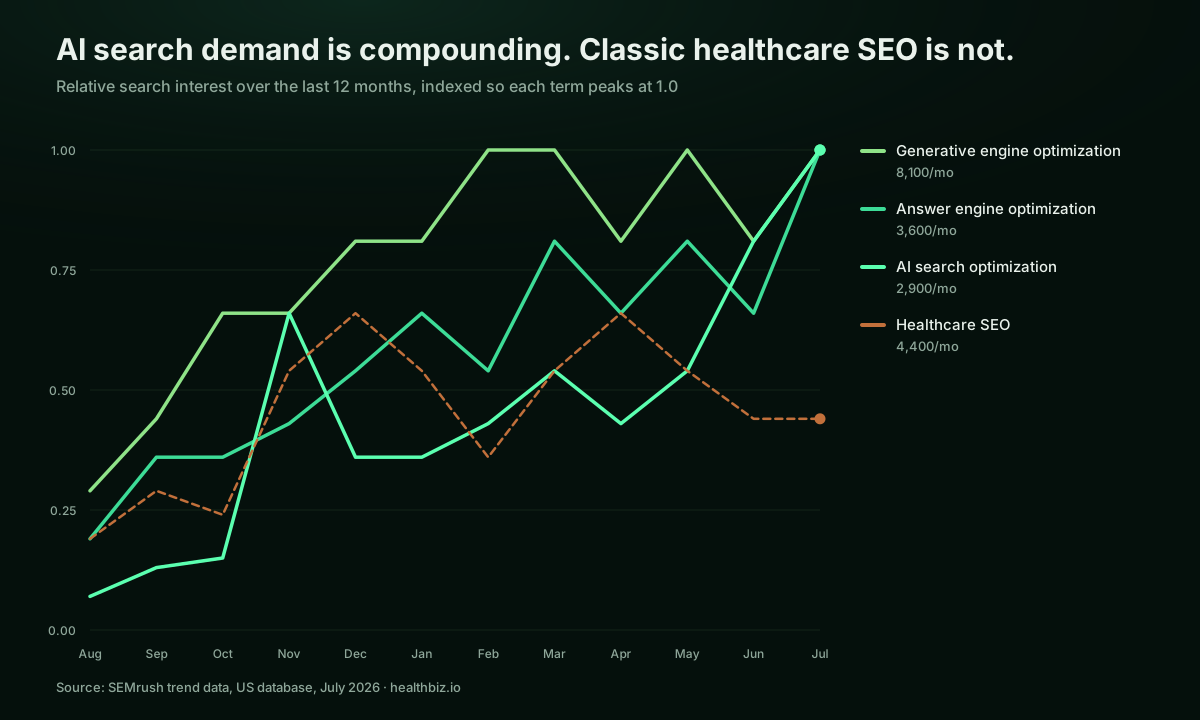
The demand curve says this is the year to build. Search interest in "AI search optimization" grew roughly fourteenfold over the past 12 months, from a trend index of 0.07 to 1.00 (SEMrush trend data, July 2026), and the term now draws about 2,900 searches a month. Meanwhile ChatGPT alone passed 800 million weekly users in 2026, and Google shows AI Overviews on a large share of health queries. Patients are already asking these systems who to see. The only question is whose practice comes back.
The five surfaces and how they differ
All five major AI search surfaces retrieve from a live index and cite sources, but they differ in which index they use, how they pick citations, and how patients use them. You do not need a separate strategy per surface. You need one foundation plus a small set of surface-specific adjustments, which is what the rest of this playbook delivers.
| Surface | Retrieval leans on | Citation behavior | What moves the needle most |
|---|---|---|---|
| Google AI Overviews | Google's index | Cites a handful of pages, often overlapping top organic results | Traditional Google SEO plus extractable answer-first content |
| ChatGPT | Bing-based search layer plus OpenAI crawling | Small citation set, favors direct answers and roundups | Bing indexing, published pricing/logistics, third-party mentions |
| Perplexity | Its own crawler plus web index | Heavy, visible citations on every claim | Clear factual claims, strong pages for specific questions, reviews |
| Gemini | Google's index and knowledge graph | Blends knowledge-graph entity data with cited pages | Entity consistency, Google Business Profile, structured data |
| Copilot | Bing's index | Similar to ChatGPT, Bing-dependent | Bing Webmaster Tools, same foundation as ChatGPT |
Read the last column as one list and the pattern is obvious: two indexes (Google and Bing), one entity, and one content standard cover all five surfaces. That is why the playbook is sequenced the way it is.
One scope note. This article is the cross-surface operating playbook: the audit, the foundation, the cadence, and who on your team does what. For the tactical deep dive on one surface, how ChatGPT specifically retrieves, cites, and can be tested prompt by prompt, see ChatGPT SEO: How to Get Your Practice Cited by AI. Use that one when you are executing on ChatGPT; use this one to run the whole program.
Step 1: Run the AI visibility audit
The audit answers one question per surface: when a realistic patient asks about your specialty in your city, does your practice appear, and is what appears accurate? It takes about two hours, requires no tools beyond the five products themselves, and produces the baseline every later decision depends on. Skipping it means you will optimize blind and never know whether anything worked.
Build a prompt set of 10 to 15 real patient questions. Pull them from your intake forms, your front desk's most-asked questions, and your review content. For a hormone clinic that set might include:
- "Best bioidentical hormone replacement clinic in [city]"
- "How much does HRT cost per month without insurance in [city]?"
- "Is [Practice Name] good? Any complaints?"
- "Doctor in [city] who treats perimenopause without just prescribing antidepressants"
- "What labs should I get before starting testosterone therapy, and who does that near me?"
Adjust the pattern for your model: med spas get price and comparison questions, chiropractors get condition and technique questions, IV therapy gets logistics and safety questions, naturopathic and functional medicine get philosophy and "will they actually listen" questions.
Run every prompt on all five surfaces, each in a fresh session. Log four fields in a spreadsheet: surface, prompt, mentioned yes/no, and cited sources. Then run your three nearest competitors through the same grid. When you are done you will have a visibility matrix that shows exactly where you are strong, absent, or misrepresented, and whose pages are winning the citations you want.
Two findings show up almost every time anyone runs this audit on a practice site. First, practices are far more visible on Google AI Overviews than anywhere else, because Overviews inherit their existing Google SEO. Second, practices are nearly absent from ChatGPT and Copilot because nobody ever set up Bing. Both findings convert directly into the next two steps.
Step 2: Build the entity foundation
An entity foundation means every system that describes your practice agrees on the basics: name, address, phone, specialty, providers, credentials, and services. AI systems cross-reference sources before they commit to a claim about a medical business, and inconsistency is read as uncertainty, which gets you hedged answers or silence. This step is unglamorous and it is the highest-leverage work in the entire playbook.
Work through it in this order:
Index coverage in both engines. Verify your site in Google Search Console and Bing Webmaster Tools. Submit sitemaps to both. Fix coverage gaps in Bing even when Google looks clean; the two indexes disagree constantly, and Bing feeds both ChatGPT and Copilot. Confirm your robots.txt and any bot-protection layer are not blocking bingbot, OAI-SearchBot, ChatGPT-User, or PerplexityBot. Security plugins block AI crawlers by default more often than you would think.
NAP and description consistency. Your practice name, address, phone, and one-sentence description should be character-for-character consistent across your website footer, Google Business Profile, Bing Places, Healthgrades, Yelp, your state association listing, and any specialty directories (IFM's find-a-practitioner listing, A4M's directory, and similar). Make a single source-of-truth document and reconcile everything against it.
Structured data. Add MedicalClinic or Physician schema plus LocalBusiness markup with your NAP, geo coordinates, opening hours, and medicalSpecialty. Add Person schema for each provider with credentials, education, and sameAs links to their professional profiles. Schema is how you state facts about your entity in a format machines do not have to guess at.
Provider credibility in crawlable text. Every provider bio should state board certifications, training, years in practice, and conditions of focus, in plain HTML text, not in an image or a JavaScript widget that crawlers may skip. Health queries are treated as high-stakes by every one of these systems, and pages with verifiable clinical authorship are systematically safer to cite. This is the same E-E-A-T foundation from the complete healthcare SEO guide, and it pays twice now: once in Google rankings and again in AI citations.
Your site itself must be readable by machines. If your site is a page-builder soup that loads content via client-side JavaScript, some crawlers see an empty shell. Server-rendered text, fast load times, and clean heading hierarchy are prerequisites, not niceties. If a rebuild is on your roadmap anyway, the medical website design guide covers how to build one that both patients and crawlers can actually read.
Expect this step to take two to four weeks of part-time work for a typical single-location practice, and expect it to be 60 percent of your total result.
Step 3: Restructure content so machines can quote it
AI surfaces cite pages that state answers directly, attribute claims to credentialed authors, and cover one topic per page. The content standard is simple to describe and rare in the wild: every important page answers its core question in the first two or three sentences, then elaborates. If your pages open with brand poetry, the elaboration never gets read because the page never gets cited.
Apply the standard in this order of priority:
Service pages first. One page per service, answer-first. What it is, who it is for, what it costs (a range is fine), what a visit involves, how to book. Pricing deserves special emphasis: cost questions dominate patient prompts across every surface, and the practice that publishes numbers gets cited while competitors who hide pricing do not. I have yet to see an exception.
Condition pages second. One page per condition you meaningfully treat: Hashimoto's, PCOS, low testosterone, chronic fatigue, whatever your caseload actually looks like. Use question-phrased H2s ("Can a functional medicine doctor help with Hashimoto's?") and answer each in the first sentences under the heading. These pages are what get retrieved when a patient describes symptoms instead of naming a service.
Comparison and decision pages third. "Functional medicine vs conventional endocrinology for thyroid care." "Semaglutide vs tirzepatide: how we decide." Patients ask AI systems comparison questions constantly, and almost no practice publishes honest comparison content, so the citations go to national content farms by default.
Three structural rules apply to all of it. Keep paragraphs to two to four sentences. Use tables for anything with numbers (pricing tiers, lab panels, treatment timelines), because tables extract cleanly. And put a named, credentialed author on every clinical page with a visible review date.
This is answer engine optimization applied to a medical context, and the full structural system, including how to handle YMYL review requirements, is in the AEO for healthcare guide. For the off-site half, earning the roundup mentions, reviews, and press citations that generative engines lean on for recommendation queries, work through the GEO guide. And if you want this expressed as a checklist of discrete moves for a functional medicine practice specifically, the 40 AI search plays breaks the entire program into individual plays you can assign.
Step 4: Measure on a fixed cadence
AI search measurement means re-running your audit prompt set on a schedule and tracking three numbers: mention rate (what share of prompts include you), citation share (whose pages get cited), and accuracy (is what appears correct). There is no Search Console for ChatGPT, so your prompt log is the rank tracker, and it only works if the cadence is fixed rather than "whenever someone remembers."
The cadence I install:
Monthly, 60 minutes: re-run the full prompt matrix across all five surfaces. Log mention rate and citation sources. Flag any inaccurate answer for immediate source-tracing (find the stale page or listing feeding the error and fix it that week).
Monthly, 15 minutes: check analytics for AI referral traffic. Filter for referrers including chatgpt.com, perplexity.ai, gemini.google.com, and copilot.microsoft.com. Counts will start small; the trend line is what matters, and these visitors book at unusually high rates because they arrive pre-sold by the answer that sent them.
Every intake, 5 seconds: add "AI assistant (ChatGPT, etc.)" as an option on your "how did you hear about us" field. Self-reported attribution is imperfect, but it catches the large share of AI-influenced patients who read an answer, then Google your name and arrive as "direct" or "branded search" traffic.
Quarterly, 90 minutes: review the trend. Which prompts flipped from absent to mentioned? Which competitor gained citations, and from what new source? Reallocate next quarter's content and citation-building work accordingly.
Set expectations honestly with yourself and your team. Entity and index fixes typically show up in answers within two to six weeks. Content restructuring shows up over one to three months. Reputation-level dominance of recommendation prompts, where you are the default answer for "best [specialty] in [city]," takes six to twelve months of consistent corroboration building. This is a compounding asset, not a campaign.
Step 5: Make it a team workflow, not a project
AI search optimization fails in practices when it is one person's side project, and it sticks when the recurring pieces are assigned to roles with a cadence. The good news is the recurring workload is small: after the initial six-to-eight-week build, maintenance runs about four to six hours a month across the whole team.
Here is the division of labor that works in a typical independent practice:
- Owner or practice manager (monthly, 1 hour): runs the prompt matrix, owns the visibility log, decides priorities. This job needs judgment, not technical skill.
- Front desk (continuous, minutes a day): review requests on a fixed trigger (every completed care-plan visit, for example), and logging the "how did you hear about us" field faithfully. Reviews are the cheapest citation source you have, and the front desk controls the flow.
- Clinicians (monthly, 1 to 2 hours): review one new or updated condition page for accuracy and put their name on it. Clinical authorship is a citation asset only a clinician can provide, and the time cost is one coffee's worth per month.
- Marketing person or agency (monthly, 2 to 3 hours): publishes or restructures one to two pages to the answer-first standard, maintains directory consistency, and pitches one third-party mention (roundup inclusion, local press, podcast) per month.
Write these into your existing meeting rhythm: the prompt-matrix results get two minutes in your monthly ops meeting, right next to new-patient numbers. What gets reviewed monthly gets done monthly.
Questions practitioners actually ask
Do I need this if my Google rankings are already strong? Yes, and you are starting from the best possible position. Strong Google SEO carries you in AI Overviews and partially in Gemini, but it does nothing for ChatGPT and Copilot if Bing cannot see you, and it does not fix unstructured pages that no engine can quote. Practices with strong classic SEO usually get the fastest AI search wins because the foundation is half-built; the functional medicine SEO guide and this playbook are designed to run as one system.
Which surface should I prioritize? Sequence by patient behavior, not by hype. For most practices in 2026 that means Google AI Overviews first (largest share of health queries today), ChatGPT second (largest standalone AI audience and the fastest-growing referral source), then Perplexity, Gemini, and Copilot, which largely inherit the same foundation work anyway.
Can this hurt me? What about hallucinated medical claims? The risk of doing nothing is higher than the risk of participating. AI systems will answer questions about your practice whether or not you engage; your only control is the quality of the sources they retrieve. The accuracy check in your monthly cadence exists exactly for this: when an answer misstates your services or pricing, trace the source and correct it at the origin.
Should I buy an AI visibility tracking tool? Not in year one. The manual prompt matrix costs an hour a month, keeps you close to the actual patient experience, and teaches you what the tools measure. Consider paid tracking when you are managing multiple locations or the manual log becomes the bottleneck.
The practices that win AI search over the next two years will not be the ones with the biggest budgets. They will be the ones that ran the audit, fixed the boring entity work, restructured their pages so machines could quote them, and then measured on a schedule while competitors debated whether AI search was real. Every step in this playbook is doable in-house with the instructions above. If you would rather hand the whole system to a team that runs it for functional medicine and cash-pay practices every day, that is what Health Biz Scale is for. Either way, run the audit this week. The baseline you record today is the before picture you will be very glad you have.