
SEO for doctors is the work of making your practice show up when a patient searches for the problem you solve, the treatment you offer, or your name. For an independent practice, it breaks into three jobs: local SEO (your Google Business Profile and map rankings), on-site content that proves expertise, and technical hygiene that lets Google trust and crawl your site. Done in that order, most single-location practices see meaningful movement in 4 to 9 months.
I want to be upfront about who's writing this. I'm not a doctor. I'm a software engineer with 20 years in enterprise systems, and I helped build a platform from zero to $500 million. I've also been a functional medicine patient for 15 years, which means I've spent a lot of hours searching for practitioners the way your future patients do. Today I run an agency that does this work for functional medicine and cash-pay practices, so everything below comes from campaigns I actually run, not theory.
One more framing note before we start. If your practice is cash-pay, or moving that direction, SEO is not optional. You don't have an insurance network feeding you referrals. Every patient chose you on purpose, and most of them started that choice with a search. That's the whole game.
Why SEO works differently for doctors
Google classifies health content as "Your Money or Your Life" (YMYL), which means medical pages are held to a higher trust standard than nearly any other category. Practically, that means your rankings depend less on keyword tricks and more on demonstrated expertise: named authors with credentials, accurate claims, and a site that looks like it belongs to a real clinical practice.
This is the single biggest thing generic SEO advice gets wrong for physicians. The tactics that work for a SaaS blog (volume publishing, aggressive keyword insertion, anonymous content) can actively hurt a medical site. Google's quality systems ask, in effect: would a patient be harmed if this page were wrong, and does the site show evidence that a qualified person stands behind it?
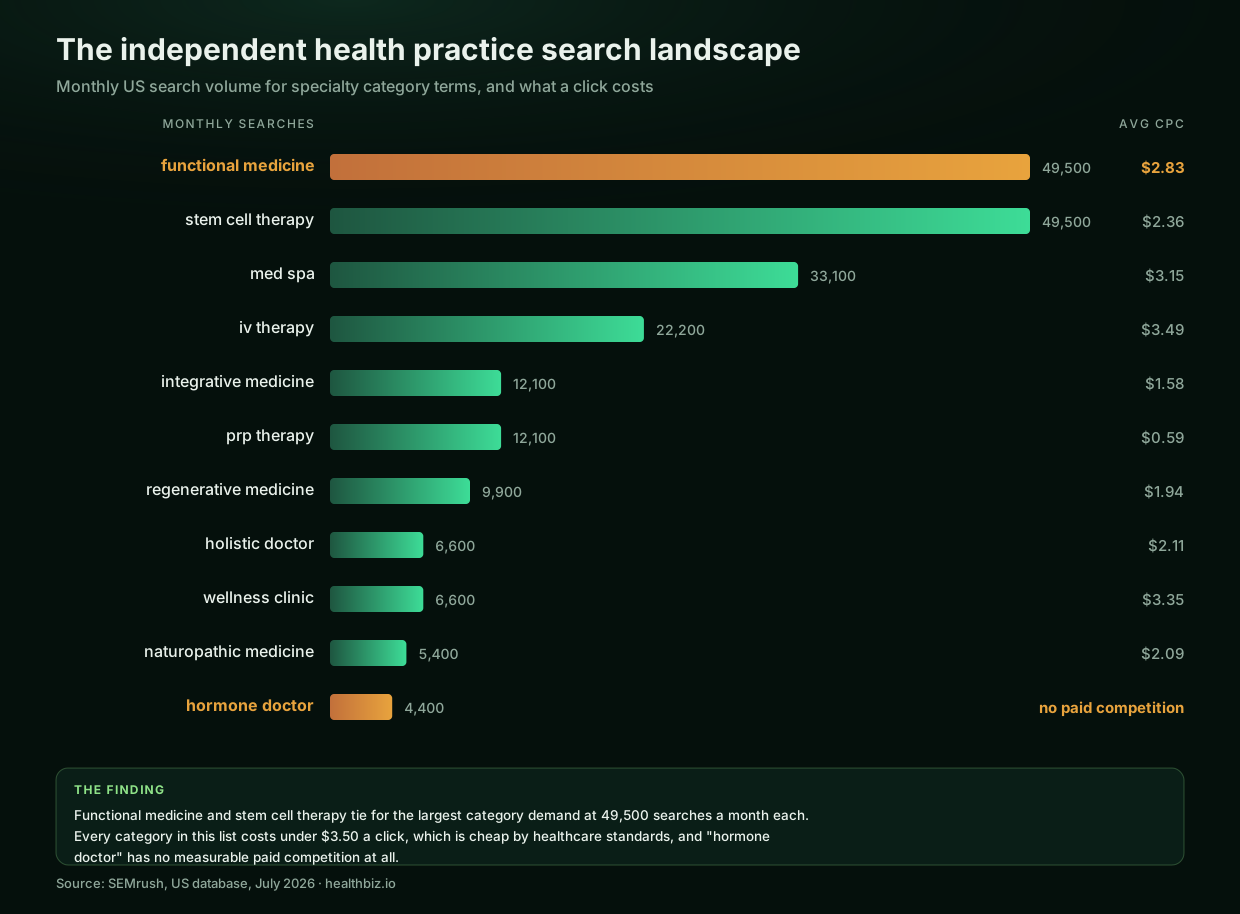
The upside is real, though. When I pulled the numbers on "seo for doctors" as a search term, it gets around 2,900 searches a month with almost no serious competition on the content side. The same pattern holds across most physician-adjacent keywords: patients are searching constantly, and the practices competing for that attention are mostly doing it badly. A modest, consistent effort beats most local competitors because most local competitors are doing nothing.
For a deeper treatment of the trust mechanics, my complete healthcare SEO guide goes further into E-E-A-T and YMYL. This article is the practical playbook version.
Local SEO comes first for almost every practice
For a single-location practice, local SEO produces new patients faster than anything else in this guide. Your Google Business Profile (GBP) ranks in the map pack, the map pack sits above most organic results for "near me" and "[specialty] + city" searches, and patients call directly from it. If you do nothing else from this article, fix your GBP.
Here's the priority order I use with clients:
1. Claim and complete your Google Business Profile. Every field. Primary category set to your actual specialty (not "Doctor" if "Functional Medicine Practitioner" or "Naturopathic Practitioner" exists and fits). Services listed individually. Hours accurate. Real photos of the office and providers, not stock.
2. Fix your NAP consistency. Name, address, phone: identical everywhere. Your website, GBP, Healthgrades, Yelp, insurance directories if you're listed, state licensing boards. I've watched a practice lose call volume for months because three different phone numbers were floating around the citation ecosystem. Google sees conflicting data and trusts none of it.
3. Build a review engine, not a review request. Reviews are a top-three local ranking factor and the top conversion factor. The practices that win don't ask for reviews occasionally; they have a system where every discharged or completed-visit patient gets a request at the moment satisfaction peaks. I wrote a full patient reviews guide covering the workflow, HIPAA-safe response templates, and what to do about negative reviews.
4. Create real location and service pages. One page per core service, written for the patient, with the city and the condition language they actually use. Not ten thin pages stamped out of a template.
A note on review responses: never confirm someone was a patient. "Thank you for the kind words" is fine. "We loved treating your thyroid condition" is a HIPAA problem. Respond to everything, confirm nothing.
E-E-A-T: what Google actually wants from a medical site
E-E-A-T stands for Experience, Expertise, Authoritativeness, and Trustworthiness, and for doctors it translates to one instruction: put your credentials on everything. Google's systems try to verify that a qualified human stands behind medical claims, so your job is to make that verification easy.
The checklist I run on every new client site:
- Author bylines on every clinical article, linked to a real bio page with degrees, licensure, board certifications, and a photo. "By Dr. Sarah Chen, ND, IFMCP" outranks "By Admin" in trust terms every time.
- A substantial About page for the practice and each provider. Training, philosophy, affiliations. This page gets read by patients and evaluated by Google.
- Citations to reputable sources when you make clinical claims. Linking to PubMed or a specialty society doesn't leak authority; it builds it.
- Reviewed-by structure if a non-clinician writes your content. A marketer can draft; a provider must review and be named.
- HTTPS, a privacy policy, a real address, and a working phone number. Basic trust signals that a surprising number of medical sites still miss.
Experience, the first E, is where independent physicians hold an advantage no content farm can copy. You've treated the condition hundreds of times. Write like it. "In our practice, the most common reason this protocol stalls is..." is a sentence an AI content mill cannot honestly produce, and both patients and ranking systems respond to it.
Content strategy: topical authority beats random blogging
A medical blog with 40 disconnected posts ranks worse than a site with 12 pages organized around one condition cluster. Google rewards depth on a topic, not breadth across topics, so the winning structure is: one pillar page per core condition or service, supported by 5 to 10 specific articles that link back to it.
Say you're a functional medicine practice where thyroid is a flagship service. The cluster looks like:
- Pillar: a comprehensive thyroid page (the condition, your approach, testing, what treatment looks like, cost expectations for cash-pay)
- Supporting articles: Hashimoto's and diet, why TSH-only testing misses cases, thyroid and fatigue, lab markers explained, medication vs. root-cause approaches, what to expect at a first visit
Each supporting article links to the pillar. The pillar links to each article. Internal links are how Google learns your site has depth, and they're the most neglected free ranking lever I see.
Where do topics come from? Three sources, in order of value:
- What patients ask you in the room. Every question you answer three times a month is an article.
- Your reviews and intake forms. Patients describe symptoms in their own words ("exhausted all the time," "brain fog"), and those words are the keywords. Clinical vocabulary is often the wrong vocabulary.
- Keyword tools last. Volume data confirms priorities; it shouldn't set them.
On quality bar: one genuinely useful 1,500-word article a month beats four thin 400-word posts. YMYL punishes shallow content. If you can't say something a patient couldn't get from WebMD, don't publish the page yet.
Technical SEO: the 20% that matters for a practice site
Most technical SEO advice is written for sites with 100,000 pages. A practice site has 30 to 80 pages, which means the technical work reduces to a short list you handle once and then check quarterly.
- Speed and mobile. Most patient searches happen on phones. If your site takes six seconds to load on mobile, you're losing patients before they see a word. Compress images, drop the autoplay video header, test on a real phone.
- One H1 per page, and make it the topic. Sounds trivial. I've fixed sites where the theme wrapped the logo in an H1 on every page, which muddies what each page is about.
- Titles and meta descriptions written for humans: "Thyroid Treatment in Austin | [Practice Name]" not "Home - Welcome."
- Schema markup. Physician, MedicalClinic, or LocalBusiness schema tells Google exactly who and where you are. It takes an hour to implement correctly.
- No orphan pages, no broken links, an XML sitemap submitted in Search Console.
Site design and conversion are their own discipline, and a fast site that fails to convert visitors into booked calls is only half fixed. My medical website design guide covers that half.
AI search: the channel forming right now
Patients increasingly ask ChatGPT, Perplexity, and Google's AI Overviews the questions they used to type into search, and those systems cite sources with a strong bias toward clearly structured, directly answered, expert-attributed content. Optimizing for this (often called AEO, answer engine optimization) mostly means writing the way this article is written: each section opens with a direct 2-3 sentence answer before elaborating.
What earns AI citations, based on what I track across client sites:
- Direct answers up front. An LLM extracting an answer wants the answer in the first sentences under a heading, not buried in paragraph six.
- Named expert authorship. AI systems inherit Google's trust bias toward credentialed authors on health topics.
- Specificity. "Treatment typically runs 3 to 6 months and most patients notice changes by week 6" gets cited. "Results vary" doesn't.
- Entity clarity. Your practice name, provider names, location, and specialties stated consistently across your site and your citations, so the model knows who you are.
Here's the important strategic point: AEO is not a separate project. Every recommendation in this article (structured content, credentials, direct answers, topical depth) serves both Google rankings and AI citations. You're building one asset for two channels.
Link building for doctors: authority without the spam
Backlinks (other sites linking to yours) remain a meaningful ranking factor, and for doctors the good news is that legitimate links are easier to earn than in most industries because you have something most site owners don't: real credentials. The bad news is that the link-buying schemes cold-emailed to your inbox weekly are worse than useless on a YMYL site.
The link sources worth your time, roughly in order of effort-to-value:
- Professional directories and associations. Your specialty society, IFM or similar certification directories, state association listings, hospital affiliations. These are the baseline authority signals for a medical entity, and most practices haven't claimed half of them.
- Local links. Chamber of commerce, local business associations, sponsorships of community events or youth sports, local news coverage. Local links reinforce exactly the geographic relevance your map rankings depend on.
- Expert commentary. Journalists constantly need credentialed sources for health stories. Services that connect reporters with experts, plus direct pitches to local health reporters, turn your credentials into links from news domains. One quote in a regional outlet is worth more than fifty directory submissions.
- Podcast guesting. Health podcasts need guests, episodes get show-notes pages, show-notes pages link to you. This also feeds the AI-search entity picture: your name and practice mentioned across independent sites is exactly the corroboration language models look for.
- Genuinely referenced content. A well-built resource (a lab-marker explainer, a local guide, original observations from your practice data) earns links passively over years. This is slow and it compounds.
What to refuse: purchased link packages, guest posts on generic "health blogs" with no real readership, and anything promising 50 links a month. On a medical site, a spammy link profile isn't just wasted money; it's a trust liability attached to the exact site Google is already scrutinizing harder than most.
Realistic cadence for an independent practice: a handful of good links per quarter. That's genuinely enough in most local markets, because your competitors are earning zero.
Timelines, budgets, and what results actually look like
Realistic expectations: a practice in a small or mid-size market doing consistent work sees early movement (map pack improvement, first page-one rankings on long-tail terms) in 3 to 4 months, and meaningful patient volume from organic in 6 to 9 months. Competitive metros run longer. Anyone promising page one in 30 days is selling you something that will embarrass you later.
What "consistent work" means in hours, if you're doing it in-house:
| Activity | Frequency | Time |
|---|---|---|
| GBP updates, photos, posts | Weekly | 30 min |
| Review requests + responses | Ongoing (systematized) | 30 min/week |
| One substantial article | Monthly | 4-6 hours |
| Service page creation/improvement | Monthly | 2-3 hours |
| Technical check (Search Console, speed, broken links) | Quarterly | 2 hours |
| Citation audit | Twice yearly | 2 hours |
If you're hiring it out, healthcare-competent SEO retainers commonly run $1,500 to $5,000 per month depending on market and scope. Below that range, be skeptical: the economics force the vendor into templated work, and templated medical content is exactly what YMYL punishes.
And measure the right thing. Traffic is a vanity metric. The number that matters is organic-attributed new patients: track calls and bookings by source, not sessions. A client of ours, Dr. Diane Mueller, saw a 10x increase in new patient calls once the local and content foundations were in place. Calls, not clicks, is how she measures it, and it's how you should too.
Where paid ads fit alongside SEO
SEO compounds but starts slow; ads start fast but stop the moment you stop paying. For a practice that needs patients this quarter, the standard play is Google Ads for immediate demand capture while SEO builds, then a gradual rebalancing as organic volume grows. The two channels also share research: your best-converting ad keywords tell you which SEO pages to build first.
If that's your situation, I've written dedicated guides on Google Ads for doctors and Facebook Ads for doctors, plus a combined Google and Meta ads overview if you're deciding between them.
Questions practitioners actually ask
How much does SEO for doctors cost? Done in-house: roughly 10 to 15 hours a month of provider or staff time. Hired out: typically $1,500 to $5,000 per month for competent healthcare-specific work. One-time technical cleanup projects commonly run $1,000 to $3,000.
How long until I see new patients from SEO? Early ranking movement in 3 to 4 months, meaningful patient volume in 6 to 9 for most independent practices. Local SEO (GBP and reviews) often produces calls faster than that, sometimes within weeks of a serious cleanup.
Should I write content myself or hire a writer? Either works if a named provider reviews and stands behind every clinical page. What doesn't work is anonymous outsourced content with no clinical review; that's the profile YMYL exists to filter out.
Does SEO still matter now that patients use ChatGPT? More than before, in my view. AI answers are assembled from the same trust signals SEO builds, and practices with structured, credentialed content are the ones getting cited. The channel is changing shape; the underlying asset is the same.
I'm a specialist in a niche field. Is search volume too small to bother? Usually the opposite. Niche specialties have low volume but extremely high intent and almost no competition. Fifty searches a month for your exact service, in your city, from cash-pay patients, is worth more than 5,000 generic visits.
The 90-day starting sequence
If you're starting from a typical practice site, here's the order of operations:
Days 1-30: Claim and fully complete GBP. Fix NAP everywhere. Launch the review request system. Fix the worst technical issues (mobile speed, titles, H1s, HTTPS).
Days 31-60: Publish or rebuild your top three service pages with real depth, provider bylines, and direct-answer structure. Add schema. Set up Search Console and call tracking.
Days 61-90: Pick your flagship condition cluster. Publish the pillar page and the first two supporting articles. Interlink everything. Review the first data in Search Console and double down on whatever shows early movement.
That sequence is unglamorous, and it works. Most of your local competitors will never do it, which is exactly why it works.
If you'd rather hand this off, this is what my agency, Health Biz Scale, does for functional medicine and cash-pay practices specifically. But everything you need to do it yourself is in this article, and the complete healthcare SEO guide covers the parts that need more depth. Start with the Google Business Profile. Today, ideally.